Summary
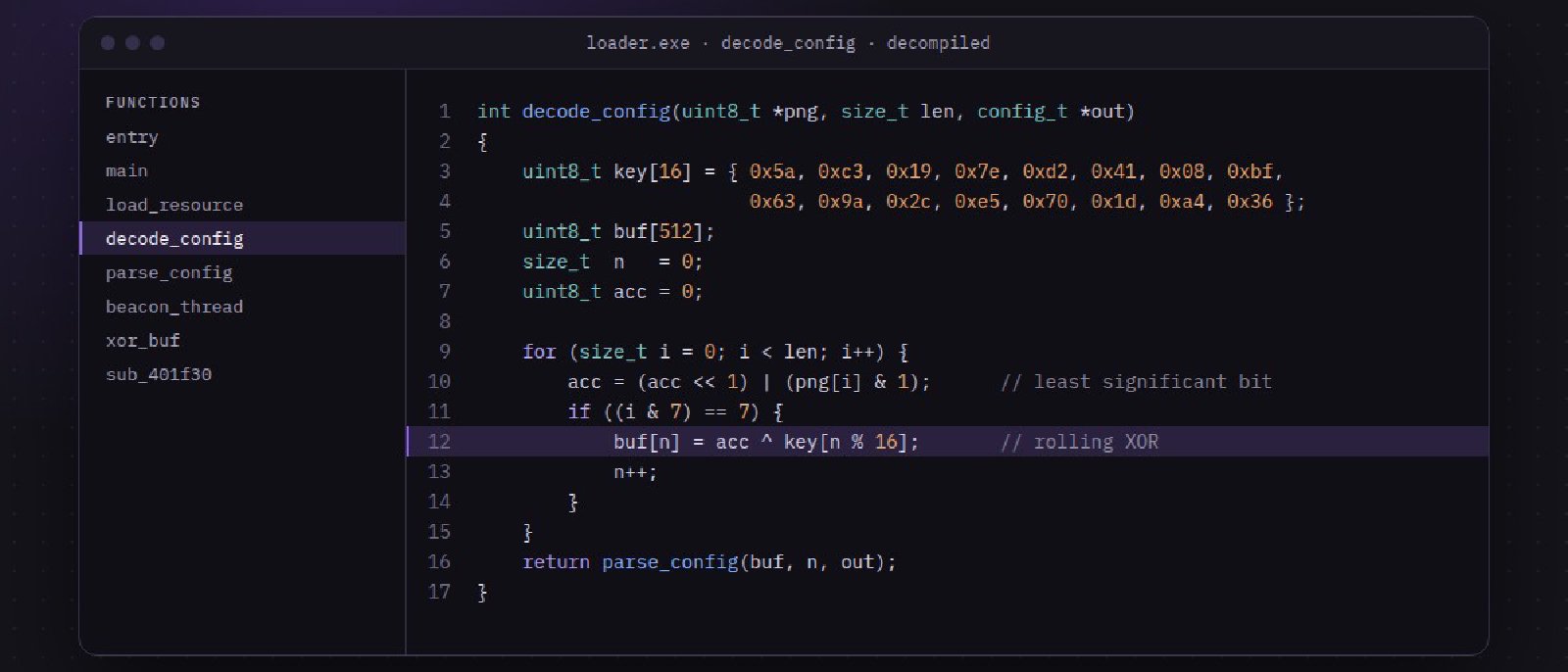
The sample is a 6 MB Go binary whose only visible behaviour is opening a picture. The picture is the payload: configuration bytes are hidden in the low bits of the pixel data and decoded at start-up with a rolling XOR. I recovered the config with a short script and no execution.
Background
Go binaries are large and carry their symbol tables, which makes them easier to navigate than most packed samples, but the runtime also buries the interesting code under thousands of library functions.
Method
I loaded the sample in a disassembler, recovered function names from the pclntab, and looked for calls into image/png. The decoder lived two calls away from main, next to a 16-byte constant that turned out to be the XOR key.
Findings
The extracted configuration lists two C2 hosts, a sleep interval with jitter, and a campaign identifier. The same key appears in three older samples, which makes it a useful pivot for hunting related files.
Takeaways
Static recovery is quick once the staging point is found. For defenders: the key and the pixel layout make a stable detection that survives repacking.