Summary
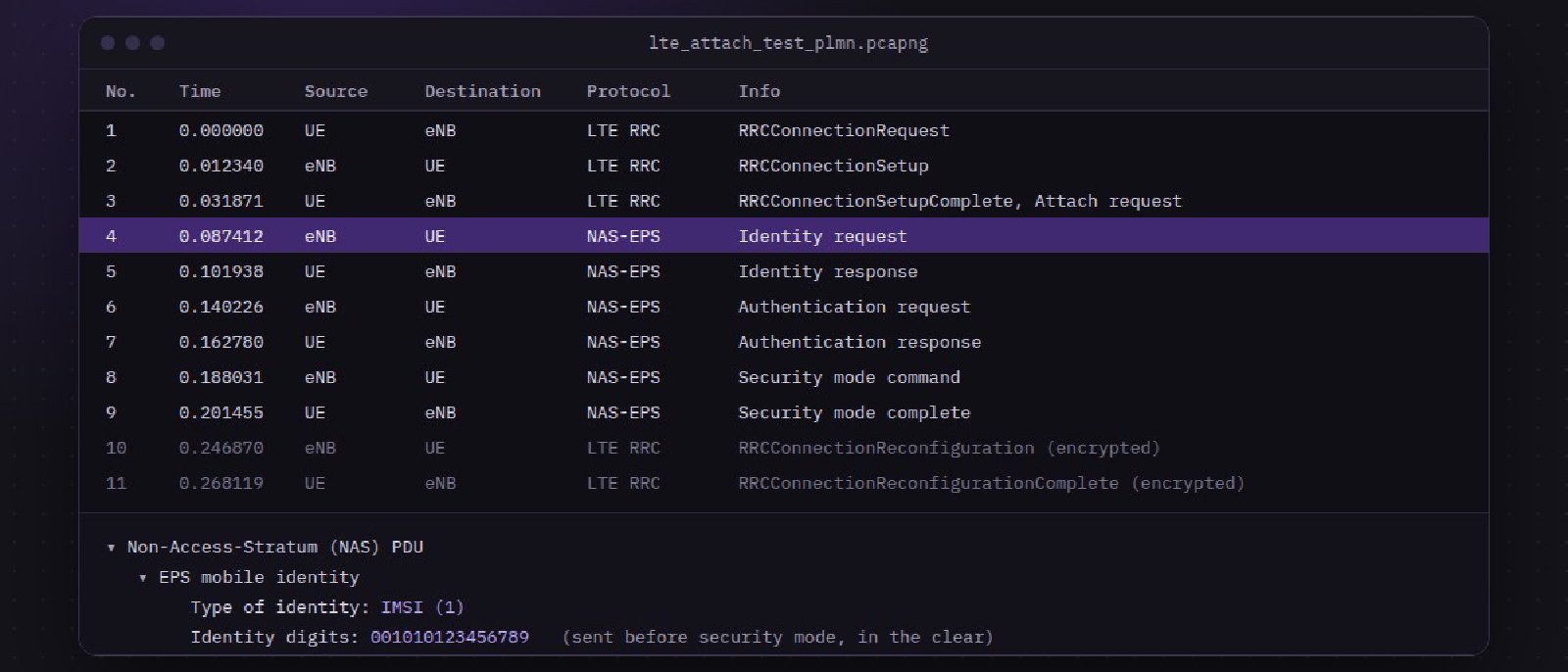
During a 4G attach, the identity request and a handful of capability messages travel before security is established. That is enough for a nearby base station to learn a permanent identifier, the device’s radio capabilities and, in some cases, which network it last registered on. The setup needed is a laptop, a USRP and an open-source stack.
Background
LTE separates the air interface from the core network, but the first messages of an attach sit in a window where neither side has agreed keys. Everything exchanged before the security mode command is readable, and a phone will usually answer a strong enough cell that claims to belong to a network it trusts.
Method
I ran srsRAN’s eNodeB against a USRP B210 inside a shielded enclosure with a test SIM, so the experiment stayed off the public network. A short script logged each attach request together with the identity and capability fields the handset volunteered.
Findings
The phone answered an identity request with its permanent identifier on the first try. Capability messages revealed the supported bands and ciphering algorithms, which is useful for fingerprinting a handset model without ever decrypting traffic.
Takeaways
Treat the attach as hostile territory. Operators can reduce exposure by preferring temporary identifiers, and 5G’s concealed identifier closes the most obvious gap, though capability leakage remains.