Summary
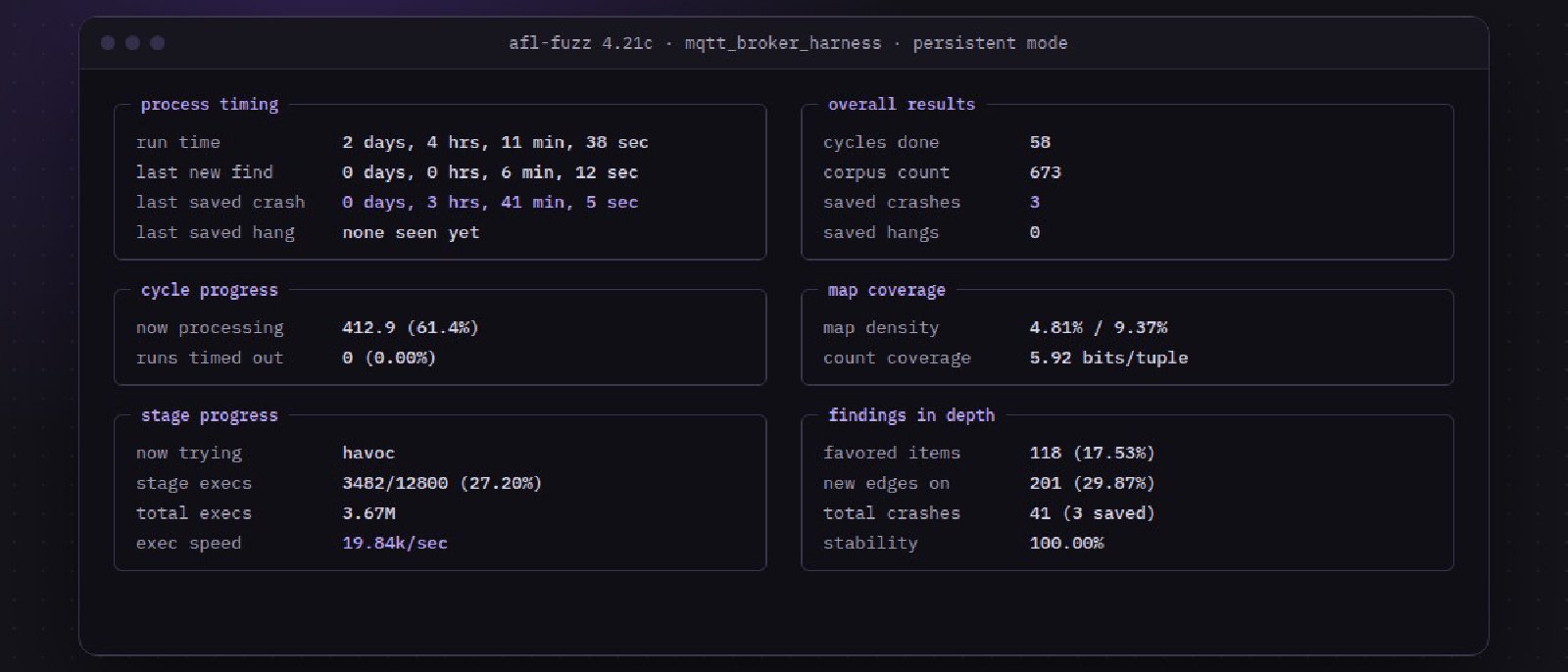
Feeding random bytes to an MQTT broker mostly exercises the first parser and nothing else, because almost every interesting handler sits behind a valid CONNECT. A harness that performs the handshake once and then fuzzes the following packets in persistent mode reached the subscription and retained-message code paths and found three memory-safety bugs.
Background
MQTT is a small publish-subscribe protocol that runs under a large amount of IoT infrastructure. Brokers are long-lived, stateful and exposed, which makes them a good fuzzing target and a worthwhile one.
Method
I split the broker’s connection handling from its socket code, replaced the network layer with an in-memory buffer, and wrapped a session setup in an AFL++ persistent loop. A small dictionary of packet types and flag bytes kept mutations structured without forcing them to be valid.
Findings
Throughput went from a few hundred to roughly 20,000 executions per second. Coverage climbed steadily for two days and then plateaued, at which point a custom mutator that rewrote the remaining-length field found two more crashes.
Takeaways
Harness quality matters more than raw speed. Spend the first day on state and reachability, and only then on performance.